Why Swordsmanship Needs Its Own Prompt Block
I gave sword technique its own block so the grip, hip turn, and blade travel stayed together inside a crowded duel prompt.
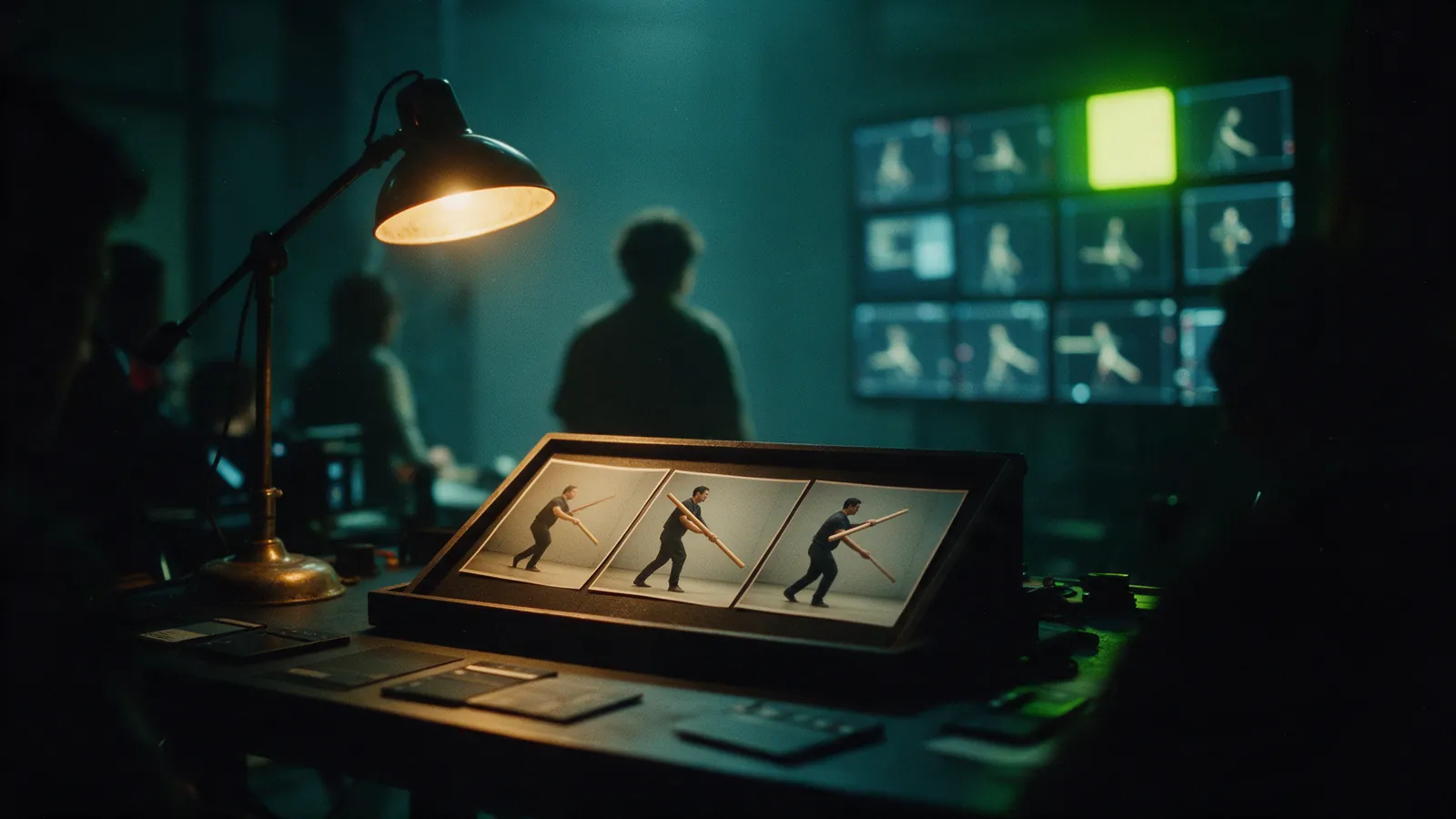
I cut the duel prompt from 2,164 words to 808, but I kept the swordsmanship dense.
That was the part I was least willing to thin out. I treated swordsmanship as ninety percent of the risk in this film. That was my assessment of where the shot could fall apart, not a measured failure rate.
The rewrite removed repetition and capital letters. It also added a block that the original template did not have: SWORDSMANSHIP.
I had been distributing those instructions between ACTION and PHYSICS. I identified the problem plainly: spread across those blocks, the technique became diluted.
The fight still needed timing, camera movement, sand, clothing, and performance. But those instructions could surround the technique without adequately defining it. I needed somewhere to read the mechanics together and decide whether I had actually directed a sword exchange.
The shot gives that problem very little cover.
The men begin four metres apart, already running. Their blades meet three times in fourteen seconds. The camera stays close and catches the duel in fragments.
Here is the opening exactly as written:
SCENE CONTEXT
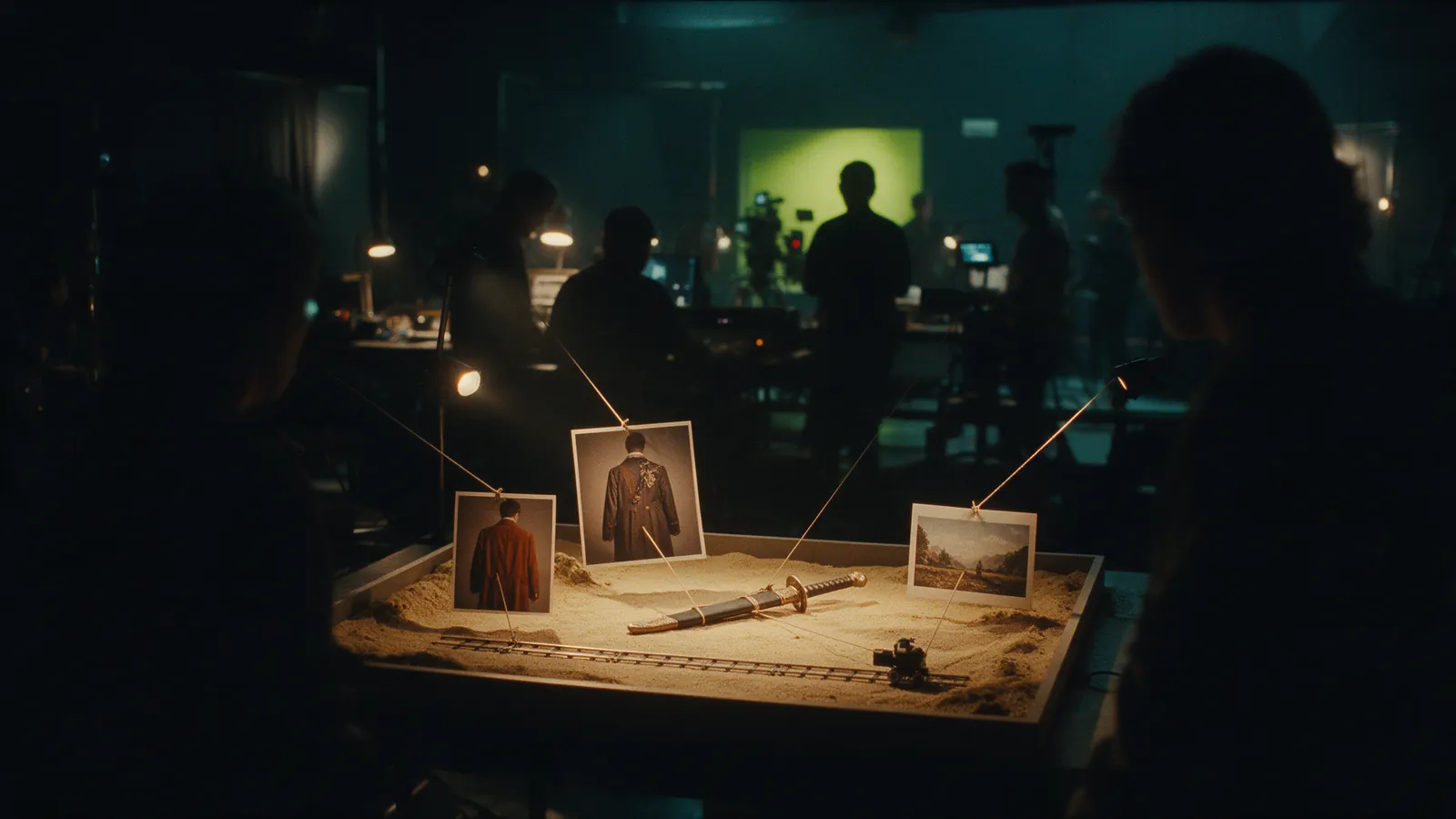
Dawn duel on raked sand, already under way. Two swordsmen close the last four metres and their blades meet three times in fourteen seconds. The camera lives inside the fight and catches it only in fragments.
The camera is inside the event. I am asking it to arrive a fraction late to each clash, with each blow already leaving as the frame reaches it.
That framing makes the mechanics worth specifying carefully. The parts I ask the camera to catch still need to belong to a coherent movement. A fragment of a cut has to come from somewhere and continue somewhere.
The ACTION block gives the exchanges their place on the clock:
ACTION
0 to 4 seconds: both men cover the last four metres at running speed and the blades meet the first time, steel on steel, and slide apart.
4 to 8 seconds: the second exchange, closer, with the camera whipping across to the far man as his hips turn into the cut.
8 to 11 seconds: the third clash, the tightest of the three, the two guards locked for a fraction of a second at chest height.
11 to 14 seconds: they break and the next attack is already loading, and the shot ends with that movement still travelling.
That tells me when the blades meet, when the distance closes, and when the men separate.
It contains a hip turn because that turn belongs to a particular exchange. But a hip turn in one timed sentence is only part of the physical instruction. I still need a common description of how the men hold the swords and carry a cut through.
That is the job I gave the additional block.
These are the complete opening sentences I wrote:
SWORDSMANSHIP
The two hands sit apart on the grip, left hand at the very end, right hand under the guard, two fists of space between them. Every cut is driven by the hips turning and the left hand pulling down, and the blade continues out the far side in one motion, finishing in the air past the body.
I only have the opening of the following sentence about guards, so I cannot reproduce the rest of that block.
What is present already shows the distinction I needed.
The first sentence places the hands. It names the end of the grip and the space beneath the guard. It gives a separation between the fists. I can inspect that instruction as a piece of blocking within the body.
The next sentence connects the hip turn, the pull of the left hand, and the continuation of the blade. It carries the movement past the body to an endpoint in the air.
I wanted that connection to remain intact through the rewrite. If I cut the sentence down to a general request for swordsmanship, I would remove the specific mechanics I had taken the trouble to write.
That does not make the wording a universal lesson in sword technique. It is the physical direction recorded for this shot. Its usefulness here comes from how explicitly it describes the movement I was asking for.
The neighboring PHYSICS block has a different responsibility:
PHYSICS
Every footfall throws sand that falls back under its own weight. Blades carry mass: they swing through and past the body, and the arms follow the steel rather than driving it. Robes lag behind the torso by a beat and settle. Real time at 24 frames per second, a shade faster than life.
Sand falls back. Robes follow the torso and settle. The steel carries mass through the swing.
Some of that touches the technique. It should. The blade cannot have one kind of movement in PHYSICS and another in SWORDSMANSHIP.
Putting the passages next to each other lets me inspect that relationship. The technique names the grip and the initiation of the cut. The physics describes the weight and continuation I want that cut to have.
The performance instructions reach into the same physical space:
Fingers reset on the grip between exchanges.
That is a small action, but it has a defined place between the larger ones. It belongs to the men performing the fight. It does not need to carry the entire explanation of their grip.
The cost of the earlier arrangement was diluted direction. I never logged a retry count or a generation bill for this change. I made it because the technique was where I judged the film most exposed, and I had scattered it.
I also had to decide whether this added block belonged in the pattern before writing the remaining thirty-seven prompts. That made the structural decision matter beyond the length of this single document.
I do not read a new heading as an enforcement mechanism by itself. The useful change is the concentration of related instructions beneath it. I can now review the grip, the source of the cut, and the blade’s continuation as one physical statement.
Today, take the technique instruction from your fight prompt and read it by itself. Check whether it still describes a complete movement when the timing and camera directions are removed.
You just watched one shot come apart, decision by decision. None of them landed there by luck.