We Reviewed 405 Frames to Audit One Finished AI Film
A timed sample of 405 frames turned the final visual audit of BORROWED WOUNDS into a defined review workload.
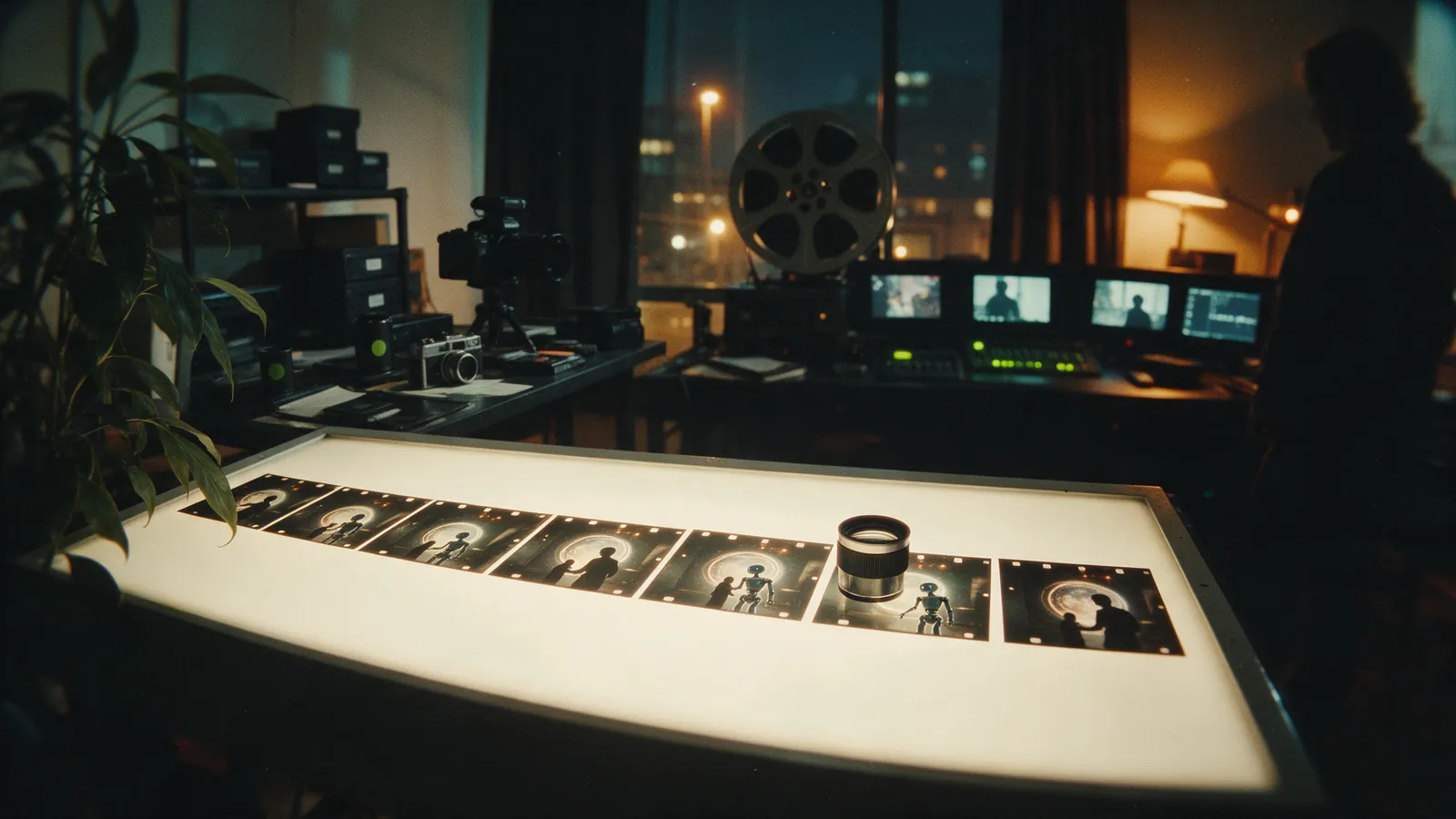
I reviewed 405 frames from the finished version of BORROWED WOUNDS.
That was not the number of frames in the film. It was the number selected for the final visual audit. The regular sample took one frame every two seconds. Critical sequences received a denser sample every half second.
That distinction matters. “Check the finished film frame by frame” sounds like an instruction. It does not tell you how much work is waiting, where to concentrate it, or when the review is complete.
A timed sample does.
| Audit measure | Recorded figure |
|---|---|
| Frames reviewed | 405 |
| Regular sampling interval | One frame every 2 seconds |
| Critical-sequence interval | One frame every 0.5 seconds |
| Cuts detected | 208 |
| Detected cuts checked | 20 |
| False cuts found in that check | 1 |
| Defensible shot estimate | Around 200, about 198 |
The sample became the workload
The useful number was 405.
Without that number, visual quality control can turn into repeated playback. I can watch the film, return to a suspect section, and still finish without a count of how much received close inspection.
The timed sample converts that vague pass into review units. Each selected frame is one item to inspect. The end condition is plain: the selected set has been reviewed.
The regular cadence was one frame every two seconds. That created the baseline across the finished file.
The half-second sampling served a different purpose. It increased scrutiny inside critical sequences. I did not need the entire film sampled at that density. I needed a consistent baseline, then a tighter pass where the normal interval was not enough.
This was a finished-film audit. It was not a replacement for reviewing generated clips earlier in production. I treated one corrupt frame as enough to invalidate a shot.
The final sample answers another question. What survived all the way into the film?
Playback is not the same as a frame audit
A sampled frame has to withstand inspection without motion carrying the sequence forward.
That is why I did not treat watching the film through as the entire visual audit. I treated a single corrupt frame as enough to invalidate a shot, so still-frame inspection had to remain part of the review.
The source file measured 2520 by 1080 at 30 frames per second. Those figures describe the file. They do not describe the review workload. The 405-frame sample does.
Resolution and frame rate tell me what the file contains. Sampling tells me what I actually inspected.
A regular interval still does not promise that every isolated defect will be selected. That is why the critical sections received half-second sampling instead of relying on the two-second baseline everywhere.
The method is not “take 405 frames from every film.” The method is to define a repeatable interval, count the resulting frames, and tighten the interval where a sequence requires more scrutiny. In this case, that process produced 405 review frames.
Cut detection gave me a map, not a final answer
The cut detector found 208 cuts.
I checked 20 of those detections. One was false. That was enough to stop treating 208 as an exact shot count.
My defensible estimate is around 200 shots, about 198. That wording is deliberate. The detector produced a precise number, but the verification showed that its output included an error. A precise detection result is not automatically a precise description of the edit.
This is another reason to keep the cut pass separate from the image pass.
The cut detector helps divide the film into editorial units. The timed sample distributes the visual review across the finished result. One measures structure. The other creates a defined quality-control workload.
Neither one gets to declare the film clean by itself.
The shot estimate also gives context to the 405-frame audit. BORROWED WOUNDS had 146 current storyboard images before the finished-film measurement. The storyboard count, detected-cut count, estimated shot count, and sampled-frame count are different records. They should not be collapsed into one number.
The storyboard planned images. The detector proposed cut boundaries. The checked detections supported an estimated shot count. The timed sample defined the final visual review.
Failed generations can still contain usable seconds
Frame review also changes how I judge a generated clip.
A generation does not have to be clean from beginning to end to contain usable footage. I can salvage useful sections lasting two to five seconds from failed generations.
That makes the review decision more specific than “good clip” or “bad clip.”
A clip may fail as a complete take and still contain a section that works. A single corrupt frame may also make an otherwise useful section unusable. The unit that matters is the clean stretch that can survive the edit.
That is why visual inspection belongs at more than one stage. Generated clips need close review so useful sections can be identified. The assembled film needs its own audit because the final cut determines which fragments remain.
The final sample is the last chance to judge what the audience will actually receive, not what looked promising in the generation list.
Production records do not replace final inspection
My production process includes a visual library, auditable asset manifests, anchors and variants, a timed storyboard, video generation, editing, sound, final scaling, and measurement.
Across 11 film manifests, I logged 1,078 asset entries. That tracking identifies what was made. It does not prove that the finished frames are clean.
The final film needed a separate measurement because my asset tracking and my inspection of final-image quality answer different questions.
A manifest can record the identifier, subject, ratio, resolution, prompt, reference, and output path for an image. The film audit can establish whether a selected frame in the finished result still holds together.
Turn the review into a count before starting it. Today, capture one frame every two seconds from your finished cut, add half-second sampling to the critical sequences, and make the resulting frame count your quality-control queue.
Credits spent, attempts counted, results measured. I trust numbers because they don't flatter anybody, least of all me.