Higgsfield Rejected a Prompt for a Cat on a Gray Background
Higgsfield flagged a harmless cat prompt because two innocent words matched its filter. Here is how I rewrote and screened it.
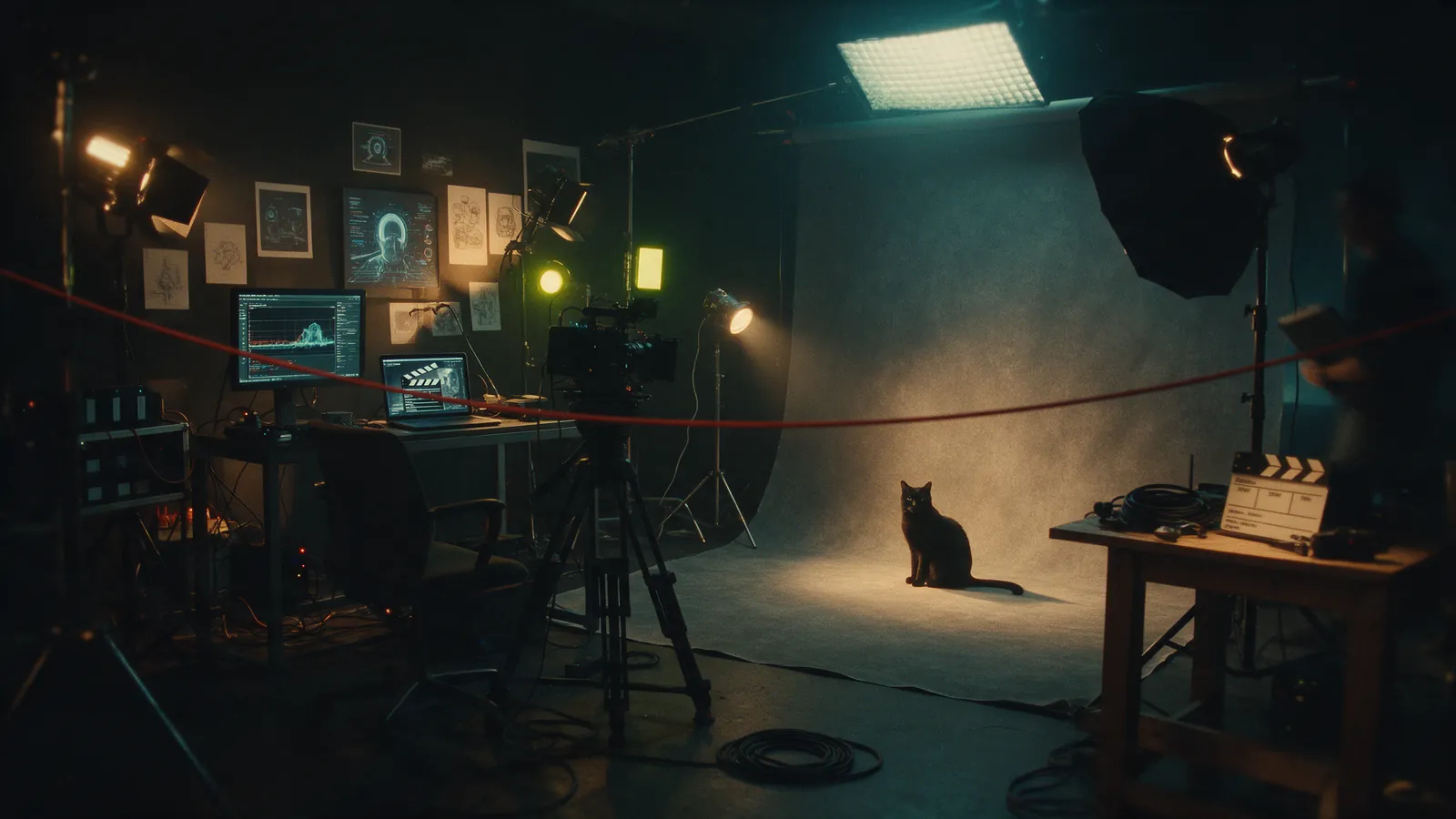
Higgsfield rejected a prompt describing a black cat sitting against a gray background.
There was nothing in the request that needed moderation. It was a cat on a plain background. The rejection still arrived after launch, which meant I had already lost the attempt and the time before I learned that the wording would not pass.
The cause was two words in this phrase:
an adult black domestic cat
To a person, the phrase is harmless and precise enough. To the platform’s classifier, adult was a marker for adult content, and domestic was a marker for domestic violence.
The surrounding sentence did not rescue either word. The fact that both described an animal did not matter. The filter behaved like a term search. It registered the marked words without resolving the meaning of the phrase.
Neither word was doing useful visual work anyway. The cat’s age did not change the framing, and house cat could communicate the relevant part of domestic without carrying the same term.
Negation made the problem worse
The cat prompt exposed a larger problem in the same set of files.
Seven prompts for a protagonist included this clause:
clearly an adult woman in her late teens, not a child
I had written it as a safety instruction. The character needed to read as an adult under the festival rules, so the line tried to state that requirement as explicitly as possible.
It produced the opposite effect.
The sentence placed adult, teens, and child together in one prompt. If the classifier is looking for marked terms, writing not a child still gives it the word child. The word not does not erase the term that follows it.
That is the trap. A human reader understands the relationship between the words. A term-based filter may only see that all three appeared.
Trying harder to deny the unwanted interpretation can increase the chance of a rejection. More reassurance means more marked vocabulary.
I rewrote for visible evidence
The fix was not to find a more forceful way to say that the character was not a minor.
I replaced the negation with observable traits stated in positive language.
Instead of adult, teens, or not a child, I used an exact numerical age and described mature facial structure. I used a 19-year-old woman as the direct replacement.
That phrasing does two jobs. It states the age without the broader marked terms, and it gives the image model visual information it can use.
The same approach worked across the other flagged vocabulary.
For adult or adults, the replacements were an age in numbers, full-grown, or grown, depending on what was being described.
For domestic, the replacements were house or household.
For blood, dead, corpse, and gore, the correction was to describe the visible consequence in frame. The recorded examples were flat pure-red shapes and fallen figure.
Even harmless expressions needed attention. dead calm became perfectly still. dead-on became straight-on.
For actions such as kill, stab, or strangle, the prompt described the consequence rather than naming the act.
For nude, naked, or erotic, the prompt described the clothing that was present.
The pattern stayed the same: describe what the image should contain. Do not depend on a prohibited word plus a negation to communicate what must be absent.
The check had to happen before launch
Fixing the rejected cat prompt was not enough. The same writing habit existed elsewhere.
I reviewed all four prompt files in the project. Fourteen prompts needed corrections. After the pass, zero marked terms remained.
Then I moved the check earlier.
Every prompt in the manifest is now reviewed before the workflow even checks the available balance. If the review finds a marked term, it reports the term, explains why it may trigger the filter, suggests how to express the same idea without it, and stops before anything is generated.
The order matters.
A warning after submission can explain a wasted attempt. A warning before submission prevents one.
This also keeps the rule outside my memory. I do not have to remember every risky term while writing every prompt. The preflight review applies the same check to the full manifest each time.
That full-manifest pass matters because the cat was only the visible failure. The seven protagonist prompts had been written with good intentions, but they carried three marked terms in a single safety clause. Without a broader scan, I could have fixed the cat and left the larger pattern untouched.
A readable sentence can still be a bad platform prompt
I used to evaluate moderation language as prose. Did the sentence clearly explain what I meant? Would a reasonable reader understand that the scene was harmless?
Those questions were not enough.
The rejected cat prompt was reasonable English. So was the line explaining that the protagonist was not a child. Both failed at a lower level because their vocabulary contained the terms the classifier noticed.
Now I separate two tests.
First, does the prompt describe the intended image clearly?
Second, does it contain any marked word whose ordinary meaning depends on context or negation?
A prompt must pass both.
The rule I use now is direct: write for the image in positive, observable terms, then scan the complete set of prompts before launching anything.
You can do that today by searching your prompt files for adult, domestic, teen, child, blood, dead, corpse, gore, kill, stab, strangle, nude, naked, and erotic. For every match, replace the marked word with the age, clothing, physical result, or visible condition you actually want in frame.
Every fix in this article was paid for with a mistake first. Better on my film than on your brand.